



SUBMERSIBLE LEVEL TRANSMITTER
Model
:
Y-LT
Type
:
Pipeline
Display
:
–
Aplication
- Accurate liquid level measurement based on the proportion principle
of liquid static pressure with height.
Suitable for: - Water supply systems.
- Industrial process control.
- Water conservancy projects.
- Environmental protection initiatives.
- Chemical industry applications.
- General liquid level measurement and control needs.
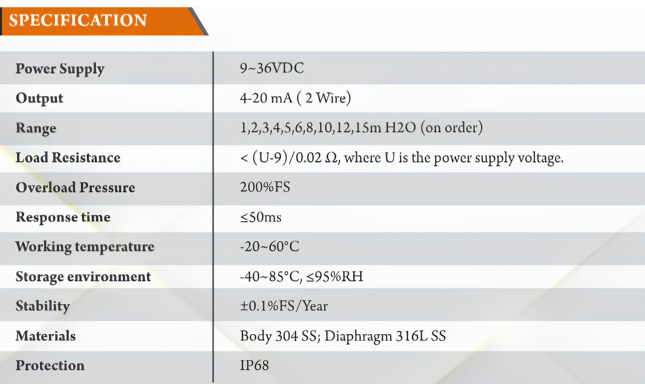
Specification
Ordering Guide
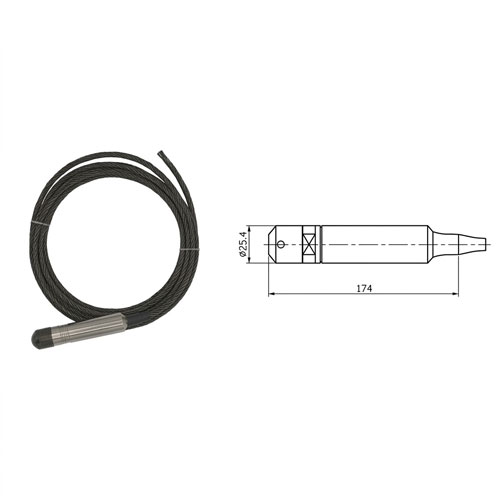


SUBMERSIBLE LEVEL TRANSMITTER: Reliable Solution for Accurate Liquid Level Measurement
A SUBMERSIBLE LEVEL TRANSMITTER is an important industrial measurement device designed to continuously measure the level of liquids in tanks, wells, borewells, reservoirs, sumps, wastewater systems, and other liquid storage or monitoring applications. By using hydrostatic pressure to determine liquid depth, a SUBMERSIBLE LEVEL TRANSMITTER provides reliable and continuous level information for process monitoring, automation, water management, and industrial control systems. With its compact design, simple installation, and suitability for challenging environments, the SUBMERSIBLE LEVEL TRANSMITTER has become a practical solution for accurate liquid level measurement across numerous applications.
Submersible Level Transmitter
A SUBMERSIBLE LEVEL TRANSMITTER is installed directly into the liquid being measured, typically by suspending or mounting the transmitter near the bottom of a tank, well, or other liquid container.
- The SUBMERSIBLE LEVEL TRANSMITTER measures hydrostatic pressure created by the liquid column above its sensing diaphragm.
- The measured pressure is converted into an electrical output signal.
- The output can be connected to a PLC, DCS, display, data logger, controller, or monitoring system.
- The transmitter provides continuous information about liquid level rather than requiring manual measurement.
- A SUBMERSIBLE LEVEL TRANSMITTER can be used in clean water, wastewater, industrial liquids, reservoirs, and many other applications.
- Its submerged installation makes it particularly useful for deep tanks, wells, borewells, and difficult-to-access locations.
- Proper selection of pressure range, probe length, material, cable type, and output signal helps achieve dependable measurement.
Level Transmitter
A Level Transmitter is an industrial instrument used to measure the level of liquids or other materials and communicate the measurement to a control or monitoring system.
- Level transmitters can use hydrostatic pressure, radar, ultrasonic, capacitance, differential pressure, or other measurement technologies.
- A Level Transmitter provides continuous level measurement for automation.
- It can help operators monitor tanks and vessels without physically inspecting the liquid level.
- Level transmitters can support alarm generation when a liquid reaches predefined levels.
- They are widely used in water treatment, manufacturing, chemical processing, agriculture, and utilities.
- Selecting the appropriate technology depends on the liquid characteristics and installation environment.
- A SUBMERSIBLE LEVEL TRANSMITTER is particularly useful when the sensor needs to be placed directly inside the liquid.
Submersible Level Sensor
A Submersible Level Sensor is designed to operate while immersed in liquid and measure the liquid level continuously.
- The sensor is commonly installed close to the bottom of a tank, well, or reservoir.
- It detects hydrostatic pressure generated by the liquid above the sensing element.
- The measurement can be converted into a standard industrial output.
- A Submersible Level Sensor is useful for applications where overhead mounting is inconvenient.
- It can be used for monitoring water levels in wells, borewells, tanks, and reservoirs.
- Robust construction can help the sensor operate in demanding environments.
- A SUBMERSIBLE LEVEL TRANSMITTER combines this submerged sensing approach with transmitter functionality for integration into monitoring systems.
Water Level Transmitter
A Water Level Transmitter continuously measures the level of water in tanks, wells, reservoirs, and other storage systems.
- It helps monitor available water volume and changes in water level.
- A Water Level Transmitter can provide continuous measurements for automated systems.
- It is useful in municipal water management and industrial water storage.
- Water treatment plants can use level transmitters for process monitoring.
- Agricultural systems can use water level measurement for reservoirs and irrigation storage.
- The transmitter can be connected to remote monitoring systems.
- A SUBMERSIBLE LEVEL TRANSMITTER is a suitable option when continuous water level measurement is required from inside a tank or well.
Liquid Level Transmitter
A Liquid Level Transmitter is used to determine the level of liquids in storage vessels, tanks, process systems, and other containers.
- It can be used for water and various compatible industrial liquids.
- A Liquid Level Transmitter supports continuous measurement instead of manual level checking.
- It can improve visibility into liquid inventory.
- Industrial facilities can integrate level measurements with automated control systems.
- The selection of wetted materials should consider liquid compatibility.
- Pressure range should match the expected liquid depth.
- A SUBMERSIBLE LEVEL TRANSMITTER can be used where direct immersion provides a convenient measurement method.
Level Sensor
A Level Sensor detects or measures the level of material inside a container or process system.
- Level sensors may provide point-level detection or continuous measurement.
- Point-level sensors indicate whether a material has reached a specific position.
- Continuous sensors provide ongoing information about the level.
- A Level Sensor can be used for tank monitoring, water management, process control, and automation.
- Different technologies are available for different applications.
- Hydrostatic sensors are particularly useful for liquid-level measurement.
- A SUBMERSIBLE LEVEL TRANSMITTER provides continuous level measurement using pressure-based sensing.
Submersible Level Sensor
A Submersible Level Sensor is designed for direct immersion in liquids and is commonly used in deep tanks, wells, boreholes, and reservoirs.
- The sensing element measures pressure caused by the liquid column.
- Installation is generally straightforward when suitable mounting and cable arrangements are available.
- The sensor can continuously monitor changes in liquid level.
- A Submersible Level Sensor can reduce the need for manual level inspection.
- It is useful for applications where the liquid surface is difficult to access.
- Proper venting and cable installation are important for pressure-based measurement systems.
- A SUBMERSIBLE LEVEL TRANSMITTER can provide a standardized output from the submerged measurement point.
Water Level Sensor
A Water Level Sensor is used to determine the height or presence of water within a storage or process system.
- Water level sensing is important for tanks, reservoirs, wells, sumps, and treatment systems.
- A Water Level Sensor can support automatic monitoring.
- Continuous water level measurement can help operators understand consumption and replenishment patterns.
- Sensors can be connected to controllers and monitoring equipment.
- Proper installation helps prevent mechanical damage and measurement problems.
- The required sensing range should correspond to the actual water depth.
- A SUBMERSIBLE LEVEL TRANSMITTER is commonly selected for continuous water level measurement in submerged applications.
Hydrostatic Level Transmitter
A Hydrostatic Level Transmitter determines liquid level by measuring the pressure generated by the liquid column.
- Hydrostatic pressure increases as liquid depth increases.
- The transmitter converts pressure into a corresponding level measurement.
- Liquid density should be considered when applying hydrostatic measurement principles.
- A Hydrostatic Level Transmitter can be used in tanks, wells, reservoirs, and process vessels.
- It is especially useful for water-level applications.
- Proper range selection helps maintain suitable measurement performance.
- A SUBMERSIBLE LEVEL TRANSMITTER generally operates according to this hydrostatic measurement principle.
Tank Level Transmitter
A Tank Level Transmitter provides continuous information about the amount of liquid inside a tank.
- It can support inventory monitoring.
- It can help identify low-level and high-level conditions.
- A Tank Level Transmitter can be integrated with pumps and control systems.
- It can support automated filling and draining operations.
- Industrial tanks can benefit from continuous level monitoring.
- Water storage tanks can also use level transmitters to monitor available capacity.
- A SUBMERSIBLE LEVEL TRANSMITTER can be installed inside suitable tanks for direct hydrostatic measurement.
Best Submersible Level Transmitter
Choosing the Best Submersible Level Transmitter requires evaluating the application rather than selecting a device based only on price.
- Determine the maximum liquid depth that needs to be measured.
- Select a pressure range appropriate for the installation.
- Check the required electrical output, such as a standard current or voltage signal.
- Consider the liquid’s chemical characteristics.
- Review the transmitter’s housing and diaphragm materials.
- Check the operating temperature range.
- Consider cable length and installation requirements.
- Evaluate environmental protection and ingress resistance.
- Confirm compatibility with the PLC, controller, or monitoring system.
- A reliable SUBMERSIBLE LEVEL TRANSMITTER should match the actual operating conditions of the application.
Submersible Level Transmitter for Water Tanks
A Submersible Level Transmitter for Water Tanks provides continuous measurement of water depth inside storage tanks.
- It can be positioned near the bottom of the tank.
- Hydrostatic pressure changes as the water level rises or falls.
- The transmitter converts this pressure into a measurable output.
- Tank operators can use the output for local or remote monitoring.
- The system can support automated pump control when integrated with suitable controllers.
- It can help identify low-water and high-water conditions.
- A SUBMERSIBLE LEVEL TRANSMITTER can simplify continuous monitoring compared with manual measurement.
- It is suitable for many industrial, commercial, agricultural, and utility water storage applications.
Submersible Level Transmitter for Industrial Applications
A Submersible Level Transmitter for Industrial Applications can be used for continuous level measurement in demanding environments.
- Industrial facilities often require reliable measurement for water, wastewater, process liquids, and storage systems.
- A transmitter can provide real-time level information to control systems.
- It can support pump automation.
- It can assist with process monitoring.
- It can reduce dependence on manual inspection.
- Industrial environments may require robust materials and suitable environmental protection.
- Chemical compatibility should be evaluated before installation.
- A SUBMERSIBLE LEVEL TRANSMITTER can be integrated into industrial instrumentation networks.
- Correct calibration and installation are important for maintaining dependable measurements.
Digital Submersible Level Transmitter
A Digital Submersible Level Transmitter combines submerged level measurement with modern electronic signal processing and monitoring capabilities.
- Digital electronics can support consistent signal processing.
- Depending on the model, digital interfaces or configuration options may be available.
- Digital systems can simplify integration with modern monitoring equipment.
- A Digital Submersible Level Transmitter can be suitable for automated water and industrial measurement systems.
- Digital configuration may allow certain operating parameters to be adjusted.
- The transmitter should be selected according to the required communication and output architecture.
- A SUBMERSIBLE LEVEL TRANSMITTER with digital functionality can support modern instrumentation requirements.
Accurate Submersible Level Transmitter
An Accurate Submersible Level Transmitter is important when liquid level information is used for control, inventory management, or process decisions.
- Select a suitable measurement range.
- Use a transmitter appropriate for the liquid density.
- Install the sensing probe at the correct position.
- Protect the cable from unnecessary mechanical stress.
- Follow the manufacturer’s installation instructions.
- Maintain proper electrical connections.
- Periodically verify the measurement where application requirements demand it.
- Avoid installations that expose the sensing diaphragm to unnecessary physical damage.
- A properly selected and installed SUBMERSIBLE LEVEL TRANSMITTER can provide dependable continuous level information.
Submersible Water Level Transmitter
A Submersible Water Level Transmitter is designed specifically for continuous measurement of water depth.
- It can be used in storage tanks.
- It can monitor wells and borewells.
- It can measure reservoir water levels.
- It can support wastewater applications when suitable materials are selected.
- It can provide an electrical signal for remote monitoring.
- The device can be connected to data acquisition systems.
- A Submersible Water Level Transmitter is useful where direct immersion is preferred.
- A SUBMERSIBLE LEVEL TRANSMITTER can help automate water level monitoring and control.
Submersible Level Transmitter for Borewell
A Submersible Level Transmitter for Borewell is designed to measure water depth in deep underground wells.
- The transmitter can be suspended inside the borewell.
- It measures hydrostatic pressure related to the water column.
- It can provide continuous water-level information.
- Borewell monitoring can help operators understand changes in groundwater level.
- The appropriate probe length should correspond to the installation depth.
- Cable selection is important for deep installations.
- Mechanical protection should be considered during installation.
- A SUBMERSIBLE LEVEL TRANSMITTER can provide a practical method for continuous borewell water-level monitoring.
Submersible Level Transmitter for Wastewater Monitoring
A Submersible Level Transmitter for Wastewater Monitoring can help measure wastewater levels in tanks, sumps, lift stations, and treatment systems.
- Wastewater environments can contain suspended solids and other contaminants.
- The transmitter should therefore be selected according to the application conditions.
- Suitable materials can improve compatibility with the monitored liquid.
- Continuous level measurement can support pump operation.
- Level information can help reduce overflow risks when integrated with suitable alarm systems.
- Treatment facilities can use level data for process monitoring.
- Regular inspection may be appropriate depending on the wastewater characteristics.
- A SUBMERSIBLE LEVEL TRANSMITTER can support automated wastewater-level monitoring when correctly specified.
Hydrostatic Submersible Level Transmitter for Water Measurement
A Hydrostatic Submersible Level Transmitter for Water Measurement uses the relationship between liquid depth and hydrostatic pressure.
- The pressure at the sensing point depends on the height of water above it.
- As the water level rises, hydrostatic pressure increases.
- As the water level falls, hydrostatic pressure decreases.
- The transmitter converts these pressure changes into an electrical measurement.
- This measurement can then be displayed or processed by an external system.
- Hydrostatic measurement is particularly useful for water-level applications.
- Correct pressure-range selection is important.
- A SUBMERSIBLE LEVEL TRANSMITTER based on hydrostatic measurement can provide continuous water-level data.
Submersible Level Transmitter for Liquid Level Monitoring
A Submersible Level Transmitter for Liquid Level Monitoring can provide continuous information about liquid depth in various applications.
- It can be used for storage tanks.
- It can be used in process vessels where submerged measurement is suitable.
- It can monitor water reservoirs and sumps.
- It can support wastewater systems.
- It can be integrated with PLC-based automation.
- It can support remote monitoring through compatible control systems.
- Application-specific material compatibility should always be evaluated.
- A SUBMERSIBLE LEVEL TRANSMITTER provides a practical approach when continuous submerged level measurement is required.
Submersible Level Transmitter Supplier in India
A Submersible Level Transmitter Supplier in India can provide instrumentation solutions for water, industrial, commercial, and process applications.
- Suppliers can help customers identify suitable measurement ranges.
- They may provide transmitters with different output configurations.
- Product selection can be based on installation depth and liquid characteristics.
- Technical support can help with installation requirements.
- Suppliers may serve applications ranging from water storage to industrial automation.
- Customers should verify specifications before purchasing.
- A reliable supplier can help ensure that the selected SUBMERSIBLE LEVEL TRANSMITTER matches the application.
Submersible Level Transmitter Manufacturer in India
A Submersible Level Transmitter Manufacturer in India develops and supplies level measurement instruments for different industries.
- Manufacturers may offer different pressure ranges and probe configurations.
- Product construction can vary according to application requirements.
- Manufacturing expertise can support customized instrumentation requirements.
- Quality control is important for pressure-based measurement equipment.
- Manufacturers can provide technical documentation and product specifications.
- Customers should review accuracy, range, materials, output, and environmental ratings.
- A professional manufacturer can help provide a SUBMERSIBLE LEVEL TRANSMITTER suited to the intended application.
Submersible Level Sensor Supplier in India
A Submersible Level Sensor Supplier in India provides sensors for submerged liquid-level measurement.
- Suppliers can support water and industrial monitoring applications.
- They can provide sensors with different cable lengths and measurement ranges.
- Customers can select products according to tank or well depth.
- Supplier support can simplify product selection.
- Installation guidance can help reduce setup errors.
- The required output should be checked before ordering.
- A suitable SUBMERSIBLE LEVEL TRANSMITTER can be selected according to the customer’s measurement requirements.
Water Level Transmitter Supplier Across India
A Water Level Transmitter Supplier Across India can support customers requiring water-level measurement equipment in different regions.
- Pan-India supply can help industries source measurement equipment for multiple locations.
- Water-level transmitters can be used in tanks, reservoirs, wells, and treatment facilities.
- Industrial customers can select products according to measurement range and environmental requirements.
- Technical specifications should be checked before deployment.
- Consistent product availability can support maintenance and replacement requirements.
- Installation support can be valuable for large-scale projects.
- A dependable SUBMERSIBLE LEVEL TRANSMITTER can support continuous water monitoring across diverse applications.
Industrial Submersible Level Transmitter in India
An Industrial Submersible Level Transmitter in India can be used in manufacturing plants, water treatment facilities, utilities, process industries, and industrial storage systems.
- Industrial facilities require continuous visibility of liquid levels.
- A transmitter can provide data for process control.
- It can support automated pump operation.
- It can help monitor water and wastewater systems.
- It can be incorporated into PLC and SCADA-based systems where compatible.
- Material compatibility should be considered for industrial liquids.
- Installation conditions should be evaluated before selecting the device.
- A SUBMERSIBLE LEVEL TRANSMITTER can provide continuous measurement for demanding industrial applications.
Benefits of Using a Submersible Level Transmitter
A SUBMERSIBLE LEVEL TRANSMITTER offers several practical benefits for continuous liquid-level measurement.
- Continuous Measurement: Provides ongoing level information instead of occasional manual readings.
- Direct Immersion: The sensing element can be installed directly into the liquid.
- Remote Monitoring: Electrical output can be transmitted to compatible monitoring equipment.
- Automation Support: Level information can be used by PLCs and controllers.
- Wide Applications: Suitable for tanks, wells, reservoirs, sumps, and wastewater systems.
- Reduced Manual Inspection: Continuous measurement can reduce the need for frequent physical level checks.
- Compact Installation: Submerged installation can be convenient where surface mounting is difficult.
- Process Visibility: Real-time level information can improve visibility into liquid storage and usage.
- Pump Control: Measurement data can support automated pump start and stop functions.
- Scalable Monitoring: Multiple transmitters can be incorporated into larger monitoring systems.
Applications of a Submersible Level Transmitter
A SUBMERSIBLE LEVEL TRANSMITTER can be used across numerous industries and facilities.
- Water storage tanks
- Industrial process tanks
- Borewells
- Open wells
- Reservoirs
- Water treatment plants
- Wastewater treatment plants
- Sumps
- Pumping stations
- Irrigation systems
- Industrial utilities
- Commercial water storage
- Rainwater storage systems
- Underground water monitoring
- Process liquid storage
How to Select a Submersible Level Transmitter
Selecting a SUBMERSIBLE LEVEL TRANSMITTER requires careful consideration of the installation and measurement requirements.
- Measurement Range: Choose a range that covers the maximum expected liquid depth.
- Liquid Type: Confirm compatibility with water, wastewater, or the intended industrial liquid.
- Output Signal: Verify compatibility with the PLC, controller, display, or data acquisition system.
- Accuracy: Select an appropriate accuracy specification for the application.
- Operating Temperature: Check the expected liquid and ambient temperature.
- Cable Length: Ensure sufficient cable length for the installation depth.
- Material: Consider the wetted materials and liquid compatibility.
- Installation: Confirm how the transmitter will be suspended or mounted.
- Environmental Protection: Check the required protection against water and environmental exposure.
- Maintenance: Consider accessibility and cleaning requirements.
- System Integration: Verify that the transmitter can work with the existing monitoring or automation system.
Installation and Maintenance of a Submersible Level Transmitter
Proper installation can help a SUBMERSIBLE LEVEL TRANSMITTER operate reliably over its intended service life.
- Install the transmitter according to the manufacturer’s instructions.
- Position the sensing element at an appropriate measurement point.
- Avoid unnecessary contact between the probe and tank walls.
- Protect the cable against excessive pulling or bending.
- Ensure electrical connections are properly secured.
- Keep the sensing diaphragm free from unnecessary physical obstruction.
- Check the installation periodically where the application requires inspection.
- Clean the sensor appropriately when deposits or contaminants may affect measurement.
- Verify the output signal if unusual readings occur.
- Follow recommended calibration and maintenance procedures.
Why Choose Yumitto for Submersible Level Transmitter Solutions?
Yumitto can help businesses and industries explore suitable instrumentation solutions for liquid-level monitoring and automation applications.
- Application-Focused Solutions: Select measurement equipment based on actual operating requirements.
- Industrial Applications: Suitable solutions can support water, wastewater, tanks, wells, and industrial systems.
- Technical Guidance: Product specifications can help customers select appropriate measurement ranges and configurations.
- Continuous Monitoring: A SUBMERSIBLE LEVEL TRANSMITTER can support reliable ongoing liquid-level measurement.
- Automation Integration: Level measurement can be incorporated into compatible control and monitoring systems.
- Wide Use Cases: Solutions can be considered for water management, industrial processes, and storage applications.
- Quality-Oriented Selection: Proper specifications help ensure the selected instrument matches the installation conditions.
- Professional Support: Customers can discuss their application requirements before selecting a suitable product.
FAQs About Submersible Level Transmitter
What is a Submersible Level Transmitter?
- A SUBMERSIBLE LEVEL TRANSMITTER is a device used to continuously measure liquid level by being immersed in the liquid.
- It typically measures hydrostatic pressure created by the liquid column.
- The measurement is converted into an electrical output for monitoring or control.
How does a Submersible Level Transmitter work?
- The transmitter is positioned below the liquid surface.
- Liquid pressure acts on its sensing diaphragm.
- The pressure corresponds to the height of the liquid above the sensor.
- Internal electronics convert the pressure measurement into an output signal.
Where is a Submersible Level Transmitter used?
- Water tanks
- Borewells
- Wells
- Reservoirs
- Sumps
- Wastewater systems
- Industrial liquid storage systems
- Water treatment facilities
Can a Submersible Level Transmitter measure water in a borewell?
- Yes, a suitable SUBMERSIBLE LEVEL TRANSMITTER can be used for borewell water-level measurement.
- The transmitter should have an appropriate pressure range and cable length.
- Installation requirements should be considered based on borewell depth.
What is the difference between a level sensor and a level transmitter?
- A level sensor detects or measures liquid level.
- A level transmitter generally converts the measured value into a usable output signal.
- A SUBMERSIBLE LEVEL TRANSMITTER combines submerged sensing with signal transmission for monitoring and control systems.
Can a Submersible Level Transmitter be used for wastewater?
- Yes, suitable models can be used for wastewater monitoring.
- The transmitter’s materials and construction should be compatible with the wastewater environment.
- The application should be evaluated for suspended solids, contaminants, and installation conditions.
What output does a Submersible Level Transmitter provide?
- Output depends on the specific transmitter model.
- Common industrial systems may use standardized electrical outputs.
- The required output should be matched with the PLC, controller, display, or monitoring system.
How do I choose the right Submersible Level Transmitter?
- Determine the liquid depth.
- Identify the liquid type.
- Select the required pressure range.
- Check the required accuracy.
- Confirm the output signal.
- Verify cable length.
- Consider material compatibility.
- Review environmental and installation requirements.
Is a Submersible Level Transmitter suitable for industrial applications?
- Yes, a suitable SUBMERSIBLE LEVEL TRANSMITTER can be used for many industrial liquid-level applications.
- It can support tank monitoring, water systems, wastewater systems, pumping stations, and process applications.
- Product selection should be based on the specific operating environment.
Choose Yumitto for Reliable Level Measurement Solutions
Accurate liquid-level measurement is essential for efficient water management, industrial automation, process monitoring, and storage control. A SUBMERSIBLE LEVEL TRANSMITTER provides a practical way to continuously measure liquid depth in tanks, wells, borewells, reservoirs, sumps, and wastewater systems. With hydrostatic measurement, submerged installation, and compatibility with suitable monitoring systems, the SUBMERSIBLE LEVEL TRANSMITTER can support a wide range of modern measurement applications.
- Choose the appropriate measurement range for your application.
- Verify liquid compatibility and installation conditions.
- Select the required output and cable configuration.
- Consider environmental protection and maintenance requirements.
- Integrate the transmitter with compatible automation or monitoring equipment.
- Contact Yumitto to explore suitable SUBMERSIBLE LEVEL TRANSMITTER solutions for your water-level and industrial measurement requirements.