



INDOOR PARTICULATE MATTER DETECTOR
Model
:
IAQ-PM
Type
:
Wall
Display
:
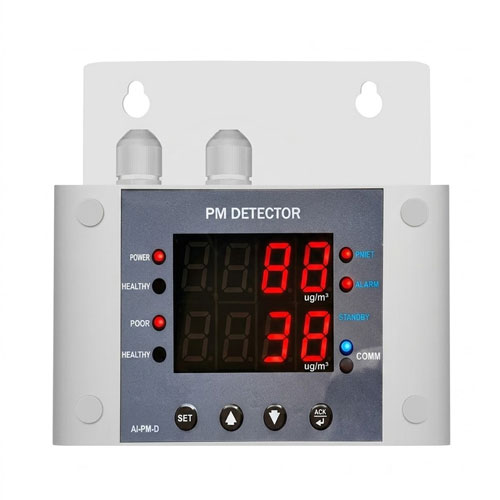
Display Available
Aplication
- Resdential and commerical indoor enviroments
- Industrial facilities
- Outdoor air quality

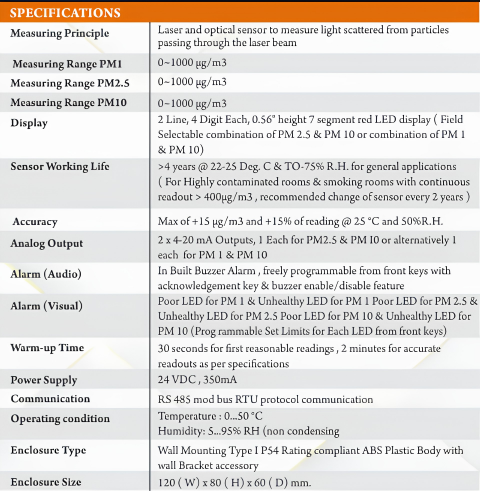
Specification
Ordering Guide



INDOOR PARTICULATE MATTER DETECTOR: Complete Guide to Indoor Air Quality Monitoring
An INDOOR PARTICULATE MATTER DETECTOR is an important air-quality monitoring device designed to detect and measure particulate matter present in indoor environments. Indoor air can contain particles generated by dust, combustion, cooking, industrial activities, construction, cleaning processes, outdoor pollution entering buildings, and other sources. Monitoring particulate matter can provide useful information about changing indoor air conditions and help facility managers, industries, offices, institutions, and other organizations understand their air-quality environment. An INDOOR PARTICULATE MATTER DETECTOR can be integrated into air-quality monitoring systems, HVAC applications, smart buildings, industrial facilities, cleanrooms, and other environments where continuous particulate monitoring is required.
Indoor Particulate Matter Detector
- An Indoor Particulate Matter Detector is designed to detect particulate matter suspended in indoor air.
- Particulate matter can include very small solid particles and liquid droplets suspended in the atmosphere.
- Indoor particulate levels can change according to occupancy, ventilation, outdoor air infiltration, cooking, cleaning, manufacturing, and other activities.
- An INDOOR PARTICULATE MATTER DETECTOR can provide continuous or periodic measurements depending on the device and application.
- Continuous monitoring can help users identify changes in particulate concentrations over time.
- These detectors can be used in offices, homes, hospitals, laboratories, warehouses, schools, industrial facilities, and commercial buildings.
- Depending on the model, the detector may monitor PM2.5, PM10, or other particulate-size categories.
- The measured information can be displayed, recorded, or transmitted to a centralized monitoring system.
- Proper sensor placement is important for obtaining representative indoor measurements.
- An INDOOR PARTICULATE MATTER DETECTOR can therefore become an important component of an indoor environmental monitoring strategy.
Particulate Matter Detector
- A Particulate Matter Detector is used to identify and measure airborne particulate matter.
- Particulate matter is commonly categorized according to particle diameter, such as PM2.5 and PM10.
- Monitoring particulate matter can provide useful information about air conditions in indoor and outdoor environments.
- A particulate detector may use optical or other sensing technologies depending on its design.
- The selected device should match the required particle-size range and measurement requirements.
- Applications can include environmental monitoring, HVAC systems, industrial processes, and building management.
- Data from a Particulate Matter Detector can be used for monitoring trends and identifying changes in air quality.
- Indoor applications require attention to airflow, placement, and environmental conditions.
- An INDOOR PARTICULATE MATTER DETECTOR is specifically intended to support particulate monitoring inside buildings and enclosed environments.
Indoor PM Detector
- An Indoor PM Detector is designed specifically for detecting particulate matter in indoor air.
- Indoor PM monitoring can help facility managers understand changes in particulate levels.
- Sources of indoor particles may include dust, cooking, combustion, cleaning, printing, manufacturing, and outdoor pollution.
- An Indoor PM Detector can be installed as a standalone monitoring device or integrated into a larger air-quality system.
- Depending on the product, the detector may provide measurements through a display, wired output, digital interface, or connected monitoring platform.
- Indoor monitoring locations should be selected according to the purpose of the measurement.
- Offices, classrooms, laboratories, hospitals, factories, and commercial facilities can use indoor PM detection.
- An INDOOR PARTICULATE MATTER DETECTOR can provide valuable particulate information for environments where air-quality visibility is important.
PM Detector
- A PM Detector is a general-purpose device for detecting particulate matter in air.
- PM stands for particulate matter.
- PM detectors may be designed for different particle-size ranges and environmental conditions.
- Some applications focus primarily on PM2.5, while others require PM10 or multiple particulate measurements.
- The detector should be selected based on the intended monitoring environment.
- Measurement range, accuracy, response time, output type, and installation requirements are important specifications.
- A PM detector can support continuous air-quality observation.
- Data can be useful for identifying patterns associated with occupancy, ventilation, and indoor activities.
- An INDOOR PARTICULATE MATTER DETECTOR provides a dedicated solution for particulate monitoring within enclosed spaces.
Particulate Matter Sensor
- A Particulate Matter Sensor is the sensing component used to detect airborne particles.
- The sensor technology determines how particles are detected and how measurements are generated.
- Optical particle sensing is commonly used in many modern air-quality monitoring devices.
- Particle sensors can be incorporated into standalone monitors, HVAC systems, air purifiers, and building automation systems.
- Sensor specifications should be evaluated according to the application.
- Factors such as particle concentration, environmental conditions, airflow, and installation location can influence readings.
- Regular maintenance may be necessary depending on the operating environment.
- A Particulate Matter Sensor can provide the measurement input required by an INDOOR PARTICULATE MATTER DETECTOR.
- Combining reliable sensing technology with appropriate installation can support consistent monitoring.
Indoor Air Quality Detector
- An Indoor Air Quality Detector can monitor one or more parameters associated with indoor air conditions.
- Depending on the device, measurements may include particulate matter and other environmental parameters.
- Indoor air-quality monitoring is increasingly relevant in offices, schools, hospitals, commercial buildings, and industrial workplaces.
- Particulate monitoring can help users understand changes in airborne particle concentrations.
- An indoor detector may be connected to a building management or environmental monitoring sys class=”heading2″tem.
- Centralized monitoring can make it easier to observe conditions across multiple rooms or zones.
- The INDOOR PARTICULATE MATTER DETECTOR can serve as a specialized component within a broader indoor air-quality monitoring solution.
- Selecting the correct device depends on which pollutants or parameters need to be monitored.
PM2.5 Detector
- A PM2.5 Detector is designed to detect fine particulate matter with an aerodynamic diameter generally at or below 2.5 micrometers.
- PM2.5 is an important particulate category for air-quality monitoring.
- Fine particles can originate from combustion, traffic-related pollution, cooking, industrial activities, and other sources.
- Indoor PM2.5 concentrations can also be influenced by outdoor air entering a building.
- A PM2.5 detector can help users monitor changes in fine-particle concentrations.
- Offices, homes, laboratories, hospitals, schools, and industrial facilities may use PM2.5 monitoring.
- Measurement specifications should be checked carefully when selecting a detector.
- An INDOOR PARTICULATE MATTER DETECTOR capable of monitoring PM2.5 can provide useful information about indoor fine-particle conditions.
PM10 Detector
- A PM10 Detector is designed to measure particulate matter with an aerodynamic diameter generally at or below 10 micrometers.
- PM10 includes a broader particle-size category than PM2.5.
- Indoor PM10 can be influenced by dust, construction, resuspension of settled particles, outdoor air, and various activities.
- Monitoring PM10 can provide information about larger inhalable particle concentrations.
- Industrial facilities and commercial buildings may benefit from PM10 monitoring where dust levels are a concern.
- The measurement range and accuracy should match the application requirements.
- PM10 measurements can be recorded over time to observe environmental patterns.
- An INDOOR PARTICULATE MATTER DETECTOR supporting PM10 measurement can be useful for comprehensive particulate monitoring.
Air Quality Detector
- An Air Quality Detector is a device designed to monitor selected air-quality parameters.
- Air-quality detectors may measure particulate matter, gases, temperature, humidity, or combinations of these parameters.
- The exact capabilities vary according to the device model.
- Indoor air-quality monitoring can help organizations observe environmental changes.
- Data can be used to support ventilation management and facility monitoring strategies.
- An air-quality detector can also be connected to automated building systems depending on its interface.
- Users should identify the required parameters before selecting a device.
- An INDOOR PARTICULATE MATTER DETECTOR can serve as the particulate-monitoring component of a wider air-quality system.
Indoor Air Quality Sensor
- An Indoor Air Quality Sensor detects one or more parameters associated with air conditions inside buildings.
- Sensors can be installed in different areas to provide localized environmental measurements.
- Particulate matter sensors are particularly useful where airborne particles are an important monitoring concern.
- Sensor placement should account for airflow, occupancy, equipment, and potential particle sources.
- Poor placement can result in measurements that do not represent the overall room environment.
- Multiple sensors can be used in larger facilities where conditions vary between zones.
- An INDOOR PARTICULATE MATTER DETECTOR can incorporate an indoor air-quality sensor specifically designed for particulate monitoring.
- Selecting the appropriate sensor technology is important for obtaining useful measurement data.
Best Indoor Particulate Matter Detector
- Choosing the Best Indoor Particulate Matter Detector depends on the intended application and required measurement parameters.
- Users should first determine whether PM2.5, PM10, or multiple particulate categories need to be monitored.
- Accuracy and measurement range should be evaluated according to the monitoring objective.
- Response time can be important when rapid changes in particle concentration need to be observed.
- Communication options should be compatible with the existing monitoring infrastructure.
- Display requirements should also be considered if local readings are needed.
- Installation method and maintenance requirements should be reviewed before purchase.
- Environmental operating conditions should match the detector’s specifications.
- A suitable INDOOR PARTICULATE MATTER DETECTOR should be selected based on actual technical and operational requirements rather than appearance or price alone.
Indoor Particulate Matter Detector for Air Quality Monitoring
- An Indoor Particulate Matter Detector for Air Quality Monitoring provides particulate measurements for indoor environments.
- Continuous monitoring can help users observe changes in particle concentrations throughout the day.
- Monitoring can be useful in offices, schools, hospitals, laboratories, factories, warehouses, and commercial buildings.
- Data can help identify periods when particulate concentrations change significantly.
- Measurements can potentially be integrated with centralized air-quality dashboards.
- Historical data can support trend analysis and facility management.
- An INDOOR PARTICULATE MATTER DETECTOR can provide the core particulate measurement needed in such monitoring systems.
- The detector should be positioned according to the monitoring objectives and manufacturer’s recommendations.
Indoor Particulate Matter Detector for Commercial Buildings
- An Indoor Particulate Matter Detector for Commercial Buildings can help facility managers monitor particulate conditions in occupied spaces.
- Commercial buildings can include offices, shopping centers, hotels, educational facilities, and other public or private spaces.
- Indoor particle levels may change according to occupancy, ventilation, cleaning, and outdoor pollution.
- Monitoring can provide useful information about variations between different areas of a building.
- Multiple detectors can be installed where large facilities contain several independent zones.
- Integration with building management systems can provide centralized visibility.
- Facility managers can use collected information as part of broader environmental monitoring strategies.
- An INDOOR PARTICULATE MATTER DETECTOR can help commercial facilities maintain greater visibility into indoor particulate conditions.
Indoor Particulate Matter Detector for Industrial Applications
- An Indoor Particulate Matter Detector for Industrial Applications is designed to monitor particulate concentrations within industrial environments.
- Industrial processes may generate dust and other airborne particles.
- Manufacturing, processing, material handling, construction, and other activities can influence indoor particle concentrations.
- Monitoring can provide useful information about environmental conditions within different facility zones.
- Industrial applications may require devices with suitable operating ranges and protective construction.
- The detector’s output should be compatible with the facility’s monitoring or automation infrastructure.
- Data logging can help organizations observe particulate trends over time.
- An INDOOR PARTICULATE MATTER DETECTOR can be incorporated into an industrial environmental monitoring system where its specifications match the operating conditions.
Digital Indoor Particulate Matter Detector
- A Digital Indoor Particulate Matter Detector can provide particulate measurements through a digital interface or display depending on the model.
- Digital monitoring can simplify data collection and integration.
- Devices may support communication with controllers, computers, dashboards, or building management systems.
- Digital interfaces can reduce the need for manual recording in automated monitoring environments.
- The communication protocol should be checked before integration.
- Digital displays can also allow users to observe readings directly at the installation location.
- Modern buildings can combine digital particulate detectors with other smart-building sensors.
- A Digital Indoor Particulate Matter Detector can therefore support both local and centralized monitoring requirements.
Accurate Indoor Particulate Matter Detector
- An Accurate Indoor Particulate Matter Detector is valuable when particulate measurements are used for monitoring and analysis.
- Users should review the manufacturer’s stated accuracy and measurement specifications.
- Accuracy can depend on sensor technology, environmental conditions, calibration, particle characteristics, and installation.
- Correct sensor placement can contribute to more representative readings.
- Regular maintenance may be necessary depending on the application and operating environment.
- Users should avoid comparing readings from different devices without considering their specifications and measurement methods.
- Calibration or verification requirements should be followed where applicable.
- An INDOOR PARTICULATE MATTER DETECTOR should be selected according to the required measurement performance and application conditions.
Indoor PM2.5 and PM10 Detector
- An Indoor PM2.5 and PM10 Detector can monitor two important particulate-size categories simultaneously.
- PM2.5 represents finer particulate matter, while PM10 covers a larger particle-size range.
- Monitoring both can provide a broader understanding of particulate conditions.
- Indoor particle sources can vary significantly between rooms and activities.
- Cooking, dust, combustion, construction, cleaning, and outdoor pollution can all influence particulate levels.
- Simultaneous monitoring can be useful in commercial, industrial, institutional, and residential environments.
- The detector’s measurement range and accuracy should be evaluated for both PM categories.
- An INDOOR PARTICULATE MATTER DETECTOR with PM2.5 and PM10 capabilities can provide more comprehensive particulate monitoring.
Indoor Particulate Matter Detector for HVAC Systems
- An Indoor Particulate Matter Detector for HVAC Systems can provide particulate information to HVAC or building management systems.
- HVAC systems influence indoor airflow and ventilation.
- Particulate monitoring can provide additional information about indoor environmental conditions.
- A detector can be installed in selected zones or locations according to the system design.
- Integration may allow monitoring data to be viewed alongside other building parameters.
- The detector’s communication interface should be compatible with the HVAC or building automation system.
- Appropriate installation is important because airflow patterns can affect particulate measurements.
- An INDOOR PARTICULATE MATTER DETECTOR can serve as one input within a larger HVAC and indoor environmental monitoring strategy.
Indoor Particulate Matter Detector for Cleanrooms
- An Indoor Particulate Matter Detector for Cleanrooms is used to monitor airborne particles in controlled environments.
- Cleanrooms require carefully managed environmental conditions depending on their application.
- Particle monitoring is an important part of many controlled-environment processes.
- Pharmaceutical, electronics, healthcare, laboratory, and specialized manufacturing environments may require particulate monitoring.
- The detector should be selected according to the cleanroom’s monitoring requirements.
- Particle-size range, sensitivity, measurement accuracy, installation method, and data-recording capabilities can be important.
- Equipment used in controlled environments should be compatible with the relevant operational requirements.
- An INDOOR PARTICULATE MATTER DETECTOR designed for appropriate particulate monitoring can support environmental visibility in controlled spaces.
Smart Indoor Particulate Matter Detector for Buildings
- A Smart Indoor Particulate Matter Detector for Buildings can connect particulate monitoring with modern building-management technologies.
- Smart building systems can collect environmental information from multiple sensors.
- Particulate measurements can be displayed through centralized dashboards depending on the system architecture.
- Automated data collection can reduce manual monitoring requirements.
- Multiple detectors can provide information from different rooms or zones.
- Smart monitoring can help facility managers identify changes in indoor environmental conditions.
- Integration with other sensors can provide broader context about temperature, humidity, occupancy, and ventilation.
- An INDOOR PARTICULATE MATTER DETECTOR with smart connectivity can support modern building monitoring requirements.
Indoor Particulate Matter Detector Supplier in India
- An Indoor Particulate Matter Detector Supplier in India can provide particulate monitoring equipment for commercial, industrial, institutional, and environmental applications.
- Buyers should review technical specifications before selecting a supplier or product.
- Important factors include PM measurement range, accuracy, response time, output interface, installation method, and operating conditions.
- Suppliers may offer different models according to application requirements.
- Technical documentation can help users determine whether a product is suitable for their intended installation.
- After-sales support can also be important for long-term monitoring projects.
- Businesses implementing multiple monitoring points may also consider product consistency and support availability.
- When sourcing an INDOOR PARTICULATE MATTER DETECTOR, buyers should consider both product specifications and supplier capabilities.
Indoor Particulate Matter Detector Manufacturer in India
- An Indoor Particulate Matter Detector Manufacturer in India can provide specialized particulate monitoring equipment for various applications.
- Manufacturers may offer different detector configurations according to measurement requirements.
- Product specifications can vary in terms of particle-size range, accuracy, output, display, enclosure, and connectivity.
- Buyers should verify technical specifications before selecting a model.
- Manufacturer support can be useful for installation, configuration, and integration questions.
- Industrial and commercial projects may require detectors with specific communication interfaces.
- Quality control and product documentation are important considerations for monitoring equipment.
- An INDOOR PARTICULATE MATTER DETECTOR should be selected according to the application’s measurement and environmental requirements.
Particulate Matter Detector Supplier in India
- A Particulate Matter Detector Supplier in India can support organizations looking for PM monitoring solutions.
- Suppliers may serve sectors including manufacturing, HVAC, building automation, healthcare, laboratories, and environmental monitoring.
- Buyers should identify the required particle-size categories before purchasing.
- PM2.5 and PM10 monitoring requirements can differ depending on the application.
- Communication requirements should also be discussed when integration with a control system is planned.
- Installation and maintenance support can be valuable for larger projects.
- Product documentation should clearly describe measurement ranges and operating conditions.
- An INDOOR PARTICULATE MATTER DETECTOR sourced from a suitable supplier can become part of a broader indoor air-quality monitoring system.
Indoor PM Detector Supplier Across India
- An Indoor PM Detector Supplier Across India can provide particulate monitoring products to customers in multiple regions.
- Pan-India supply can be useful for organizations with facilities in different cities.
- Large organizations may require consistent equipment across multiple locations.
- Product specifications should be reviewed to ensure that the same detector model is suitable for each application.
- Installation conditions can vary between facilities, making technical assessment important.
- Suppliers with technical support can assist customers during selection and implementation.
- Buyers should also consider warranty, documentation, service, and product availability.
- An INDOOR PARTICULATE MATTER DETECTOR can be deployed across multiple locations when the product specifications match the environmental requirements of each facility.
Indoor Air Quality Detector in India
- An Indoor Air Quality Detector in India can help organizations monitor selected indoor environmental parameters.
- Indoor air conditions can vary according to climate, ventilation, occupancy, building design, and indoor activities.
- Particulate monitoring is one important component of indoor air-quality management.
- Offices, schools, hospitals, factories, warehouses, laboratories, and commercial buildings can benefit from indoor environmental monitoring.
- The required measurement parameters should be identified before selecting a detector.
- Organizations may choose particulate-only monitoring or a multi-parameter air-quality system.
- An INDOOR PARTICULATE MATTER DETECTOR can provide specialized particulate measurements within a broader indoor air-quality monitoring setup.
- Product selection should be based on the specific requirements of the facility.
Why Is an Indoor Particulate Matter Detector Important?
- An INDOOR PARTICULATE MATTER DETECTOR provides greater visibility into airborne particulate conditions.
- Indoor particle concentrations can change throughout the day due to human activity and building operations.
- Continuous measurement can reveal patterns that occasional manual testing may not capture.
- Monitoring can support environmental management and facility analysis.
- Data can help users understand how ventilation, occupancy, or indoor activities influence particulate levels.
- Centralized systems can make measurements accessible to facility managers.
- Multiple monitoring points can provide information about differences between rooms or zones.
- An INDOOR PARTICULATE MATTER DETECTOR can therefore contribute to a more data-driven approach to indoor environmental monitoring.
Applications of Indoor Particulate Matter Detector
- An INDOOR PARTICULATE MATTER DETECTOR can be used in many environments where airborne particle monitoring is required.
- Offices can use particulate monitoring as part of indoor environmental management.
- Schools and educational institutions can monitor indoor particulate conditions.
- Hospitals and healthcare facilities may use specialized environmental monitoring systems.
- Industrial facilities can monitor particulate levels associated with operations.
- Warehouses can observe environmental conditions in storage areas.
- Laboratories and controlled environments can use particle monitoring according to their specific requirements.
- Commercial buildings can integrate particulate detectors into building management systems.
- Cleanrooms may require specialized particle monitoring equipment.
- Smart buildings can connect particulate measurements with other environmental sensors.
Key Factors to Consider Before Buying
- Identify whether the application requires PM2.5, PM10, or both.
- Review the detector’s measurement range.
- Check the specified accuracy and repeatability.
- Consider the required response time.
- Review the operating temperature and humidity conditions.
- Select the appropriate communication or output interface.
- Consider whether a local display is required.
- Check installation and mounting requirements.
- Evaluate maintenance and calibration requirements.
- Consider the number of monitoring points required.
- Verify compatibility with existing HVAC, BMS, PLC, SCADA, or monitoring systems.
- Choose an INDOOR PARTICULATE MATTER DETECTOR based on actual application requirements.
Installation and Maintenance
- Install the INDOOR PARTICULATE MATTER DETECTOR at a representative location within the monitored space.
- Avoid locations that may produce unusually high or low readings unless those specific conditions are the monitoring objective.
- Consider room airflow and ventilation patterns during installation.
- Avoid obstructing the sensor’s air inlet or outlet.
- Follow the manufacturer’s mounting and installation recommendations.
- Inspect the detector periodically for dust accumulation or other contamination.
- Follow the recommended maintenance schedule.
- Verify sensor performance when measurements appear inconsistent with expected conditions.
- Calibration or sensor replacement may be required depending on the product and application.
- Proper maintenance can help support long-term performance of an INDOOR PARTICULATE MATTER DETECTOR.
Benefits of Continuous Particulate Monitoring
- Continuous monitoring provides ongoing visibility into indoor particulate conditions.
- An INDOOR PARTICULATE MATTER DETECTOR can identify changes associated with occupancy and indoor activities.
- Long-term data can help users understand environmental patterns.
- Monitoring can support building-management and facility-management strategies.
- Multiple sensors can help compare different zones within a building.
- Digital data can simplify reporting and historical analysis.
- Integration with smart building platforms can make environmental data easier to access.
- Continuous monitoring can complement other indoor air-quality measurements.
- A properly selected INDOOR PARTICULATE MATTER DETECTOR can become a valuable component of a modern environmental monitoring system.
FAQs
What is an Indoor Particulate Matter Detector?
- An INDOOR PARTICULATE MATTER DETECTOR is a device designed to detect and measure particulate matter present in indoor air.
- Depending on the model, it may measure PM2.5, PM10, or other particle-size categories.
What is PM2.5?
- PM2.5 refers to particulate matter with an aerodynamic diameter generally at or below 2.5 micrometers.
- It is commonly monitored as an important fine-particle category in air-quality applications.
What is PM10?
- PM10 refers to particulate matter with an aerodynamic diameter generally at or below 10 micrometers.
- PM10 includes particles across a broader size range than PM2.5.
Where can an Indoor Particulate Matter Detector be used?
- It can be used in offices, schools, hospitals, laboratories, factories, warehouses, cleanrooms, commercial buildings, and other indoor environments.
- The appropriate model depends on the application and required measurement specifications.
Can an Indoor Particulate Matter Detector monitor both PM2.5 and PM10?
- Yes, some detectors are designed to monitor both PM2.5 and PM10.
- Buyers should check the product specifications to confirm the supported particle-size categories.
Is an Indoor Particulate Matter Detector useful for HVAC systems?
- Yes, an appropriate INDOOR PARTICULATE MATTER DETECTOR can provide particulate measurements that may be integrated into HVAC or building-management systems.
- Compatibility with the control system should be verified before installation.
What factors affect particulate matter measurements?
- Particle sources, airflow, ventilation, occupancy, sensor placement, environmental conditions, and sensor condition can affect measurements.
- Proper installation and maintenance are therefore important.
How often should an Indoor Particulate Matter Detector be maintained?
- Maintenance frequency depends on the sensor design, operating environment, and manufacturer’s recommendations.
- Facilities with high dust or particle levels may require more frequent inspection.
Can the detector be connected to a smart building system?
- Many modern particulate detectors can provide outputs or communication interfaces suitable for integration with monitoring and automation systems.
- The exact compatibility depends on the detector’s communication protocol and the building-management platform.
How do I choose an Indoor Particulate Matter Detector?
- Consider PM2.5 and PM10 requirements, measurement range, accuracy, response time, connectivity, installation conditions, maintenance requirements, and system compatibility.
- Select a device that matches the actual environmental monitoring objectives.
Where can I buy an Indoor Particulate Matter Detector in India?
- You can source an INDOOR PARTICULATE MATTER DETECTOR from specialized environmental monitoring and instrumentation suppliers in India.
- Before purchasing, compare technical specifications, application suitability, support, and documentation.
Conclusion
- An INDOOR PARTICULATE MATTER DETECTOR provides a practical way to monitor particulate matter in indoor environments.
- PM2.5 and PM10 monitoring can provide useful information about changing indoor particle conditions.
- Commercial buildings, industrial facilities, offices, schools, laboratories, healthcare facilities, cleanrooms, and smart buildings can use particulate monitoring according to their specific requirements.
- Proper detector selection should consider measurement range, accuracy, connectivity, installation conditions, and maintenance requirements.
- Continuous monitoring can provide more visibility than occasional manual measurements.
- Integrating an INDOOR PARTICULATE MATTER DETECTOR into a centralized monitoring system can also support data collection and environmental trend analysis.
- With the right specifications and installation approach, particulate monitoring can become an important part of a broader indoor environmental monitoring strategy.
Choose Yumitto for Indoor Particulate Matter Monitoring
- Yumitto offers environmental monitoring solutions designed to support modern air-quality and environmental measurement requirements.
- If your organization is looking for an INDOOR PARTICULATE MATTER DETECTOR, Yumitto can help you identify a suitable solution according to your monitoring application.
- Whether you require particulate monitoring for commercial buildings, industrial facilities, HVAC systems, cleanrooms, laboratories, offices, or smart buildings, selecting the right detector is essential.
- Contact Yumitto to discuss your particulate monitoring requirements and explore a suitable solution for your application.
- Choose the right INDOOR PARTICULATE MATTER DETECTOR to improve visibility into indoor particulate conditions and support reliable environmental monitoring.